
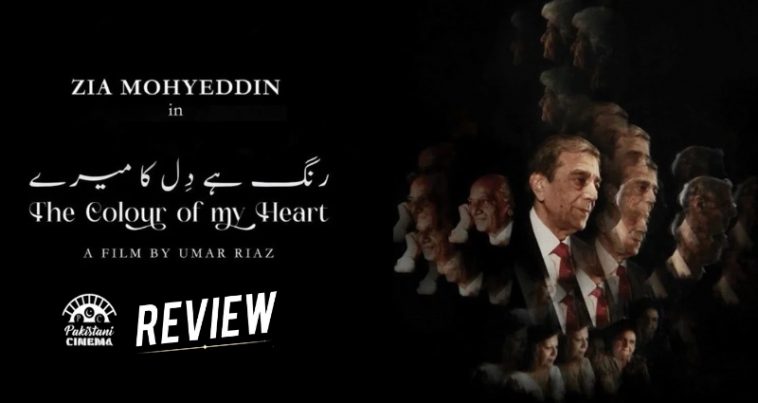
In a pivotal scene “Rang Hai Dil Ka Mere” (The Colour of My Heart), Zia Mohyeddin begins to silently weep. It barely lasts a few seconds, but its enough to colour everything that comes before and after. Is it anguish, regret, sacrifice, pride, who knows? How can one’s life be summed up in a few tears? Perhaps it can.
This documentary recounts Zia Mohyeddin’s rise in the English theater and international films, his work on Pakistan Television and English Television, and his eventual return to Pakistan to serve the country the way he knew best: through his voice.
Even if I didn’t know who Zia Mohyeddin sahab was before going into this documentary, I would’ve come out with as heavy a heart and melancholic a countenance. Zia Mohyeddin: Rang Hai Dil Ka Mere The film takes its subtitle from the eponymous Faiz Ahmed Faiz poem. The poem speaks of the iridescence that comes into one’s life when one’s beloved does. In it, the poet asks the beloved to stay a while so that of all the colours that he now sees, one may linger on and not disappear.
And there lies the essence of Zia sahab’s life. In this documentary, focusing mainly on the sunset years of his life, Zia sahab’s endeavour to keep Pakistan’s literature alive is juxtaposed against the Urdu ghazal. Zia Mohyeddin’s annual readings and his tutorship of the youth were in his eyes the endless pursuit of the beloved, as the poet pursues the beloved in the ghazal.
It’s narrated by the regal Syeda Arfa Zahra, with a few welcome appearances by Faiz Ahmed Faiz’s daughters Saleema and Muneeza Hashmi who come together as old friends who have seen all kinds of highs and lows together. They’ve seen Pakistan at its best, and the gradual decline at which we stand.
While the film is split into 3 sections; Zia Mohyeddin (his life and achievements), Faiz Ahmed Faiz (whose poetry Zia sahab greatly revered), and Daud Rehbar (cousin and mentor); it never wavers from its central theme of yearning for the beloved. Director Umar Riaz’s use of visual poetry such as a veil forever separating us from the beloved, or dancing lights in the shape of a whirling Sufi do well to remind the audience of the context. However, the same visuals appear once too often throughout the film.
Like the poem that shares its name, the documentary also focuses on the fleeting nature of life. In a sequence that focuses on the view outside a car window, Zia sahab tries to retrace his steps through his old neighbourhood in Lahore. He recounts a childhood crush on one of his classmate’s sisters; having never confessed when they were children, he met her again decades later and finally told her. Of course by then both of them were married and she could only say, “Why didn’t you tell me?”
The film also doesn’t pull any punches. It details Zia Mohyeddin’s personal shortcomings and idiosyncrasies as well as his achievements. His “particularities” as he describes them, his reservedness and absolute adherence to a covenant in service of his mission did of course earn him great praise and admiration, but it also cost him his personal relationships. He talks about the lack of closeness with his family, and his two ex wives feature in the film to talk of his fidelity to his code, along with the toll that it took on his marriages.
All in all, it’s an evocative and moving portrait of a man who lived many lives and wore many hats. However, most importantly, it’s an honest portrayal of a man who had many talents and perhaps many regrets. It’ll make you smile, weep, and it might just break your heart.
Zia Mohyeddin: Rang Hai Dil Ka Mere is playing in limited theaters now. Watch it before you mis this gem of a masterpiece.

