
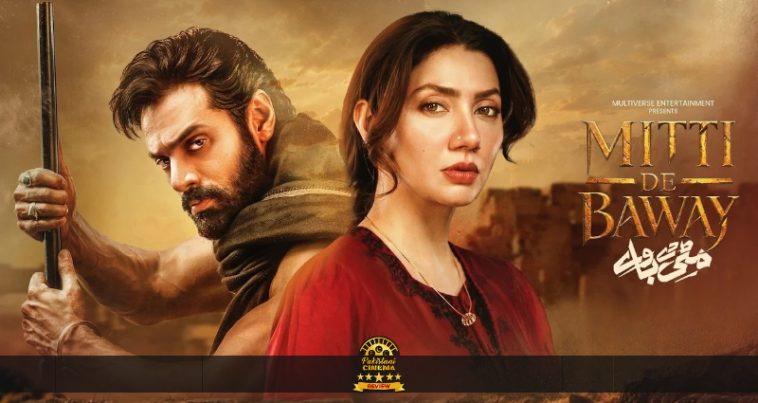
Pakistan’s cinema industry is going through a revival phase or so I’d like to believe. The reality, however, is far less encouraging. The silver screen hasn’t quite found its footing, yet television seems to be making up for it. Perhaps our television directors have taken it upon themselves to bring cinematic storytelling into our living rooms, offering viewers an experience that rivals the big screen, and that too, for free.
Green Entertainment’s ‘Mitti De Baway’ is a case in point. Just ten episodes in, the Mahira Khan and Wahaj Ali starrer has already become a phenomenon. Every Wednesday and Thursday, viewers find themselves glued to their television screens, impatiently waiting to discover what happens next. The anticipation is palpable, and the conversation around the drama continues to grow.
Flashback: Remember Mahira Khan’s ‘Humsafar’, which aired back in 2011? It was the kind of drama that brought life to a standstill, with viewers putting everything else on hold to catch the latest episode. Go further back to PTV’s golden era, and you’ll find that this was once the norm. Dramas like ‘Tanhaiyaan’, ‘Ankahi’ and ‘Waris’ became cultural landmarks, drawing audiences together in a way few television productions can today.
Back Live
‘Mitti De Baway’ isn’t just another television drama; it’s a cinematic experience. Where do I even begin? There is so much to unpack. In barely 32 minutes of screen time, including a two-minute recap, the drama delivers a roller coaster of emotions, revelations and suspense. Every episode feels like an event, leaving viewers with goosebumps and an insatiable urge for more. So, what makes ‘Mitti De Baway’ such a compelling piece of television? Let’s break down the various elements that have made it a masterpiece in the making.
‘Mitti De Baway’: The Plot
Set in Punjab, ‘Mitti De Baway’ follows the story of Iqbal Channan (Baala) and Bilqees Bano (Billo), played in their older years by Wahaj Ali and Mahira Khan, and in their younger years by Fazal Hussain and Aena Khan. Billo belongs to a wealthy Wazirabad family, while Baala is a Mirasi from Mitranawali. When they meet at her house, Baala falls genuinely in love, but Billo treats romance as a game. After his mother’s death, Baala disappears, only to return and face Billo’s classist insults. His bitter retaliation leaves a wound she carries for life.
On Billo’s wedding day, one of her former lover kills her brother, and her family, furious over her flirtatious past, abandons her. Years later, fate reunites them in Faisalabad. Billo has become spiritual and is married to Nazeer (Junaid Khan), while Baala is a cloth merchant married to Zareena (Amar Khan). But even with a second chance, old wounds, family conflicts, and betrayal threaten to keep them apart.
Writing A World To Perfection
We have witnessed the brilliance of Faiza Iftikhar’s pen in dramas like ‘Bilqees Kaur’, ‘Dil Lagi’ and ‘Ranjha Ranjha Kardi’, but with ‘Mitti De Baway’, she seems to be operating on an entirely different level. You’re not merely watching events unfold; you understand why they unfold. What makes her writing particularly effective is the way she gives her characters distinct motivations, histories and contradictions, allowing their actions to emerge from who they are rather than merely serving the plot. The narrative is peppered with mass-appeal elevation moments, and that Punjabi tadka is the cherry on top. The cultural nuances and larger-than-life, conflicts give the drama a flavour that feels both rooted and thoroughly entertaining.
Every Frame Tells A Story
Director Syed Wajahat Hussain deserves immense credit for bringing it all together. His command over the material, the performances and the overall drama does justice to the core vision, giving viewers plenty to lap up. He understands when to let a scene simmer and when to raise the stakes, ensuring that the emotional moments carry as much weight as the dramatic confrontations. The tension, arguments and counterarguments, along with the sensitivity of the relationships, are seamlessly woven into the narrative. His visual treatment gives the story a cinematic scale, along with the framing, rich Punjabi cultural, perfectly executed wardrobe, detailing of every frame in order to capture the 90’s era is done to perfection. Resultantly, the spectacle never loses sight and stands out as a rare television event that genuinely feels larger than life.
Among the many memorable moments, a few sequences deserve special mention:
Young Baala’s heartbreak: The sequence in which young Baala is heartbroken after witnessing Billo’s fling captures the vulnerability of a young man whose feelings are far more sincere than he can perhaps express.
Mai Phatta Exposes Billo: The powerful scene in which Mai Phathan (Samiya Mumtaz) exposes Billo by bringing up all the men in her life is simply phenomenal in its execution. The confrontation, the tension and the way the revelations unfold make it one of those scenes that stay with you long after the episode ends.
Billo Gate-Crashes Baala’s Sister’s Nikkah: Billo’s dramatic entry and revelation of Baala’s true identity as a Mirasi turn a family celebration into a high-voltage confrontation.
The Oath: The tense moment when Junaid Khan asks Billo to swear on the Quran that everything Mai Phathan said was true, added another powerful layer in the drama.
Achi’s Tragic End: A heartbreaking sequence that hits hard with its portrayal of grief and the subsequent migration of Billo and Baala’s families. The emotional weight of the scene, elevated by Arif Lohar’s soul-stirring vocals, makes it an absolute goosebumps moment.
An OST That Amplifies Emotions
The OST, ‘Paar Channah De’, is undoubtedly one of the highlights of ‘Mitti De Baway’. Composed by Sahir Ali Bagga with the stirring vocals of Arif Lohar, Saleema Khawaja, and Sahir Ali Bagga, adds another layer of emotion to the storytelling. It breathes life into the most crucial moments. The result is a musical experience leaving you feeling every bit of the characters’ pain, longing, and heartbreak.
Performances That Elevate the Drama
Mahira Khan delivers a performance of a lifetime. She is Billo from the word go, inhabiting the role with complete conviction, as though no one is watching. Powerful and leading from the front, she brings immense intensity and emotional depth to the character. Her expressions, body language, and effortless command over the role make Billo both formidable and deeply human. Mahira continues to evolve with every project, reaffirming why she is among the top talents in the country.
Ditto for Wahaj Ali, whose physical transformation, expressions, and voice modulation deserve immense appreciation. The actor gets under the skin of his character, channeling raw fury with remarkable ease. He brings a compelling complexity to Baala, making his rage as convincing as his moments of vulnerability. Yet another remarkable performance from an actor who is rapidly rising to the top tier.
Amar Khan strikes yet again, proving that she doesn’t need a lead role to showcase her craft. Drawing on her Punjabi roots, she delivers flawless Punjabi dialogues, bringing both authenticity and credibility to Zareena. She also looks beautiful in the role, making a strong impression with her natural performance. As a delightful bonus, her impressive singing talent added even more charm to the character. Her wardrobe deserves special mention, perfectly capturing the fashion of the ’90s. From the wedding outfits and beautiful embroidery to the choice of fabrics and even the everyday clothes she wears at home, every detail is spot-on. Every look feels authentic to the era and suits Zareena to a T.
Samiya Mumtaz is the biggest surprise. Give her any role, and she adds flesh and blood to the character, bringing it vividly to life on screen. Her postures, gestures, and mannerisms, particularly as the older Mai Phathan, are outstanding. Flawless as always, she lends the drama immense weight, authority, and authenticity.
Junaid Khan makes a strong impression despite sharing the screen with stalwarts like Mahira Khan. He holds his own ground and brings conviction to his character. Sohail Ahmed, as Phajja, is dependable as always. Fazal Hussain and Aena Khan leave a lasting impression and lay a strong foundation for the characters’ journeys.
Verdict So Far
‘Mitti De Baway’ is precisely the kind of storytelling that deserves every view it attracts not merely because of the hype surrounding it or the machinery of PR, but because it delivers on merit. It grips you from the very core with its exceptional writing, commanding performances, and intensely dramatic sequences that have set a gold standard early in its run. However, maintaining this level of high-voltage drama and narrative precision over a full broadcast schedule will be the ultimate test. We hope that the classic momentum built from the initial episodes holds strong all the way till the end.


Comments
0 comments