
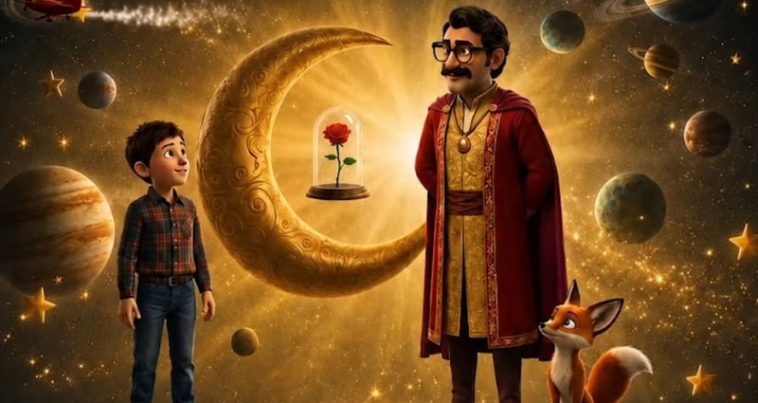
On 24th July, 2026, a Pakistani animated feature film called “Ainak Wala Jinn” was released in theaters. Based on the beloved 90s PTV children’s series, the film is a completely AI-generated 3D-animated film.
Shortly after, the original series’ creator, Hafeez Tahir posted a video on his Facebook page, criticizing the film, not only for cutting him out of the process completely, but for ruining his creation.
The trailers and teasers for the film support his concerns. Inconsistent visuals and character models, a story that has nothing to do with the original show, and poor audio/visual synchronization expose the film for what it is: AI SLOP.
What’s more, a cursory internet search reveals that the film’s visuals very closely mimic the 2015 animated film “The Little Prince”.
Generative AI is rewriting the rules globally for everything include entertainment. There has been a lot of pushback against AI slop, both online, and among artists. However, it’s a genie that can’t be put back in the bottle (pun intended).
So, the question is, is AI detrimental to art in general?
AI Use in the Pakistani Film Industry
Ainak Wala Jinn isn’t Pakistan’s first foray into AI-generated media.
The Next Salahuddin
In January 2026, the first Pakistani AI-generated film was released in cinemas. “The Next Salahuddin” was a collaboration between digital media channel “Jinn TV” from Pakistan, and Cinta Gaza Malaysia, a non profit.
The film drew attention to the plight of Palestinians and their oppression by Israel. While the intention was noble, the film suffers from all the symptoms of AI SLOP. Its television premiere, on HUM TV, drew criticism as well.
AI in Eid Features
AI shots were also notably featured in some Pakistani releases on Eid Ul Azha 2026. In both our reviews of Luv Di Saun and Psycho, we pointed out AI shots and sequences, and how they worsened the overall experience.
We reached out to one of the most respected artists in our industry about their thoughts on the subject.
Usman Riaz, director of the Glassworker, Pakistan’s first hand drawn 2D animated feature, pointed to the hesitation among artists regarding AI due to inconsistent results and a lack of understanding. However, he also pointed out its potential as a tool for organizing and assistance. He cautions, however, that AI should not take “the humanity out of art”.
The Global Criticism Against AI in Art
Of course, if the problem is a mole hill in Pakistan, it’s a mountain in other parts of the world.
Bollywood
Several films released in the Hindi film industry, Bollywood, have received criticism for using cheap AI visuals in their films.
Flicks like “Welcome to the Jungle” and “Dhamaal 4” were criticized not only for their poor plot and execution, but also AI sequences. Even the much anticipated Ramayana, has received scrutiny and criticism for perceived AI visuals.
Vikram Bhatt’s “ Haunted 3D: Echoes of the Past” was the worst offender. Almost completely shot on a green screen with AI generated visuals, it was universally panned.
Hollywood
Some readers may remember a film called “Rogue One: A Star Wars Story”. Its use of CGI to resurrect Peter Cushing in the role of Grand Moff Tarkin, and depict a young Carrie Fischer as Princess Leia was deemed controversial.
This was a decade ago.
This year, in 2026, a company named Higgsfield released a completely AI generated feature film adjacent to the Cannes film festival called “Hell Grind”. While panned as AI slop, it was made for just half a million dollars. That’s the kind of cheap production cost studios want to achieve for every blockbuster.
Fighting Back
Today, actors are putting clauses in their contracts to prevent studios from using their likeness (their face and voice) without their permission. Matthew McConaughey and Taylor Swift have trademarked theirs. In India, actors are pushing the courts to safeguard their likenesses.
Even in Pakistan, actors have spoken out for their rights. Actress Hira Tareen posted about a contract that was designed to quietly sign away her rights to her own likeness. Shamoon Abbasi also spoke about the need for safeguards.
A Hollywood writer’s strike in 2023 shuttered the industry to force studios to stop taking advantage of artists using AI across the board. It ended with an agreement that safeguarded their rights.
Threats still loom, however. While the Disney-OpenAI deal fell through, several more are in motion.
Netflix, the largest streaming platform, has bought an AI startup from actor Ben Affleck. In July, Netflix revealed that it had used generative AI for various purposes in 300 of its titles in 2026 alone. An AI generated actress named Tilly Norwood who has been bid over by studios!
It’s clear what artists, and people in general think about AI. As a tool, it maybe the next leap forward, but, the quality of work being produced is not only subpar, it’s offensive to the creativity and originality of artists everywhere.
From everyone who picks up a pencil to draw or to write, to masters of their craft in filmmaking, AI seems to be “Ctrl+C Ctrl+V” -ing from everywhere; only poorly.
As more and more people use it to cover up their creative bankruptcy, we’ll be seeing the degradation of art around the world, not just in Pakistan.


Comments
0 comments